ICOM adopts its revised Code of Ethics for Museums
The International Council of Museums (ICOM) announces the adoption of the revised ICOM Code of Ethics for Museums, a landmark step in strengthening the ethical framework that guides museums and museum professionals worldwide. The revised Code establishes minimum standards of professional practice while reinforcing the shared values and responsibilities that unite the international museum community.
On 25 June 2026, the 41st Ordinary General Assembly voted to adopt the revised ICOM Code of Ethics for Museums. The vote marks the culmination of a multi-year participatory process led by the ICOM Ethics Committee (ETHCOM) under the supervision of the ICOM Executive Board and involving consultations with ICOM’s National and International Committees, Regional Alliances, and Affiliated Organizations across the world.
The revised Code of Ethics establishes a universal ethical framework that guides museums and museum professionals in protecting and promoting cultural heritage, fostering and strengthening public trust, and serving society. Grounded in shared ethical principles, it supports museums in safeguarding, researching, and responsibly managing collections while ensuring sustainable and conscientious governance.
The revision reflects the evolving role of museums in a rapidly changing world and aligns the Code with the Museum Definition adopted by the ICOM Extraordinary General Assembly in 2022. It responds to key challenges facing museums today, including the rise of digital technologies, the climate crisis, and the ongoing need to address the legacies of colonialism through responsible and ethical museum practice.
Key Highlights of the Revised ICOM Code of Ethics
The revised Code is built around five fundamental principles that guide the work of everyone working in and with museums. These principles establish ethical and professional standards applicable to museums worldwide, including those beyond the ICOM membership.
All five principles carry equal importance in supporting sustainable, inclusive, and responsible museum practice.
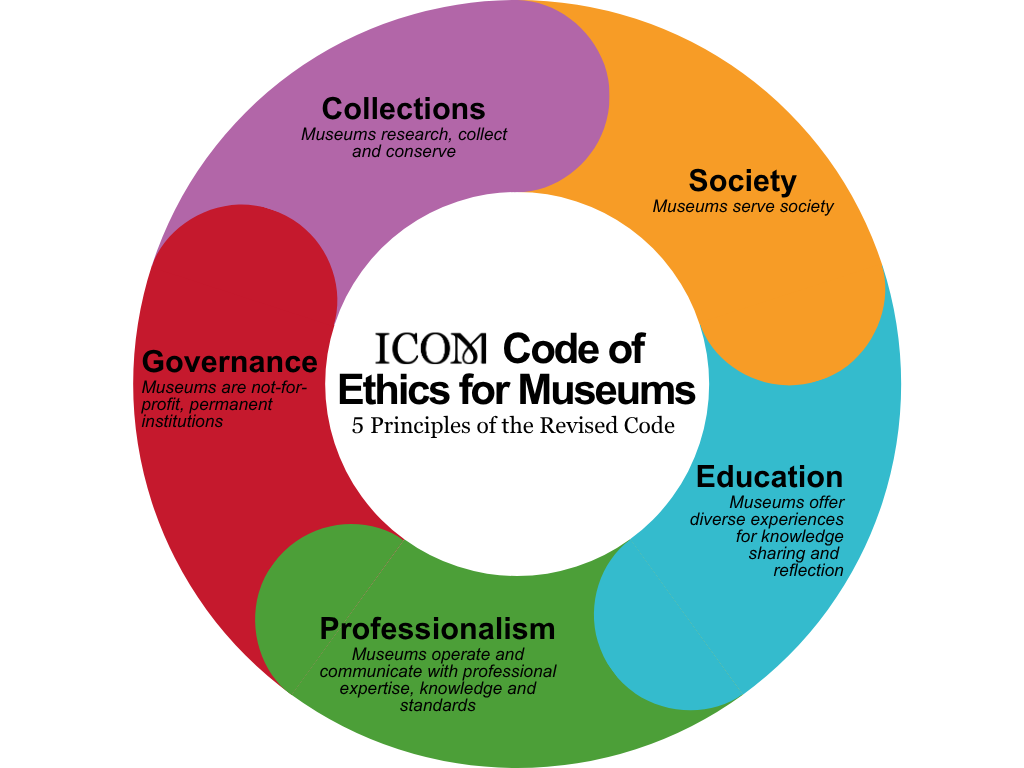
5 Principles of the Revised Code:
- Governance: Museums are not-for-profit, permanent institutions. Governing bodies and those concerned with the strategic direction and oversight of the museum are responsible for the long-term sustainability of their institution by securing the professional, physical, and financial resources necessary to maintain the museum and serve communities.
- Professionalism: To sustain society’s trust, museums operate and communicate ethically and according to professional standards. This entails responsibilities for members of the museum professions, including those in leadership roles, and for everyone who works in and with museums.
- Education: Museums offer diverse experiences for knowledge sharing and reflection. Museums’ educational activities and practices should be based on ongoing knowledge sharing and dialogue.
- Society: Museums serve society by being accessible and inclusive, collaborating with diverse communities to protect and interpret tangible and intangible heritage, and caring for their pasts, present and futures. By embracing different perspectives on heritage, museums operate as spaces for dialogue, upholding human rights, practicing social justice and promoting peace and unity.
- Collections: Museums collect, safeguard and display tangible and intangible heritage. They should ensure the security, documentation, conservation and restoration of the collections they hold. Museums conduct research and transmit knowledge in trust for society, respecting diverse perspectives and the rights of source communities.
Recognising the diversity of museums worldwide, the revised Code establishes common ethical principles while allowing flexibility for implementation across different cultural, legal, professional, and resource contexts. The revised text will be supported by practical guidance to assist museums and museum professionals in applying these principles in their daily work.
The revision of the previous Code of Ethics, adopted in 2004, began in 2020 and was completed in 2026. Throughout this six-year process, the revised Code underwent four rounds of global consultation, engaging ICOM's National and International Committees, Regional Alliance and Affiliated Organizations, in a collaborative review process. ICOM members actively contributed constructive feedback that helped refine the wording and descriptions of each principle throughout the revision process. More than 60% of the ICOM network expressed support for the revised principles.
The adoption of the revised Code marks an important milestone for ICOM and the global museum community. Building on the collaborative spirit that characterised the revision process, ICOM will keep at the heart of its work the engagement with its members to support the implementation, foster dialogue, and ensure that the Code remains responsive to the evolving realities, challenges, and needs of museums and museum professionals around the world.
About the International Council of Museums (ICOM)
The International Council of Museums (ICOM) is an international organisation of museums and museum professionals which is committed to the research, conservation, continuation and communication to society of the world’s natural and cultural heritage, present and future, tangible and intangible. As a network of experts, comprising over 60 000 professionals in 139 countries and territories, ICOM makes recommendations on issues related to cultural heritage, promotes capacity building and advances knowledge. ICOM is the voice of museum professionals on an international stage and raises public cultural awareness through global networks and co-operation programmes. ICOM is the only global organisation in the museum field.