"Artworks are not static objects with fixed meanings."
Founded in 1977, Colección FEMSA approaches its 50th anniversary in 2027, consolidated as one of the most significant collections of Latin American modern and contemporary art in the region, with a particular emphasis on Mexican art.
On the occasion of Colección FEMSA strengthening its relationship with CIMAM by becoming a Major Patron, and as it approaches its 50th anniversary, we speak with the curatorial team, made up of Paulina Bravo, Eugenia Braniff and Beto Díaz Suárez, and Laura Pacheco, Manager of Colección and Bienal FEMSA, about the collection’s evolving model, its curatorial and research practices, and how it continues to be interpreted, activated, and reimagined for the future.
The transition from the Museo de Monterrey to an itinerant model transformed the way Colección FEMSA could engage with different institutions, audiences, and contexts. Today, openness, collaboration, and mobility are three fundamental principles of your model.
How has this itinerant character influenced the way you work with museums and other cultural organizations? How does the interpretation, exhibition, or activation of artworks change when the collection enters into dialogue with different institutions and contexts?
The transition to an itinerant model has fundamentally shaped the way we understand and work with the collection. Following the closure of the Museo de Monterrey in 2000, Colección FEMSA began developing a model centered on collaboration with museums and cultural institutions in Mexico and abroad. What initially represented a transformation in how the collection operated has become one of its greatest strengths.
Rather than being tied to a single physical space, this model allows us to develop projects in dialogue with different institutions, their histories, communities, and contexts. Each collaboration becomes an opportunity to approach the collection from a different perspective, generate new interpretations, and establish connections that might not otherwise emerge.
We believe that artworks are not static objects with fixed meanings. Their interpretation can expand when they are presented in relation to different histories, territories, and audiences. This is why collaboration is central to our curatorial practice: we are interested not only in bringing artworks to different places, but also in understanding what those places can contribute to how the works are experienced and interpreted.
A current example is our collaboration with the Museo de Arte Moderno de Medellín (MAMM), where works from Colección FEMSA will enter into dialogue with the museum’s own collection. This exchange invites us to look at our pieces from a different perspective and to explore possible directions for expanding the presence of Colombian art within the collection. Such projects are developed closely with each museum’s curatorial and programming teams, bringing their interests and those of their audiences into dialogue with the diversity of our collection.
This itinerant model also makes us more aware of the interdependence among the different participants in the cultural ecosystem. We cannot operate in isolation: our work depends on the knowledge, perspectives, and contributions of the institutions and teams with whom we collaborate.
For us, the itinerant model is ultimately about keeping the collection active and relevant, while fostering meaningful exchanges with institutions and audiences across different contexts.
Research and the dissemination of different artistic practices are also part of Colección FEMSA’s mission, understanding the collection as a tool to foster critical thinking, creativity, and civic participation.
What are currently the main lines of research you develop through the collection, and how are they subsequently translated into exhibitions, public programs, or other experiences for different audiences? Could you share one project that you consider particularly significant for its capacity to transform research into participation, learning, or social impact?
Research is at the core of Colección FEMSA's work. It informs how we develop, interpret, document, and activate the collection, allowing us to approach Latin American modern and contemporary art through multiple perspectives rather than a single, definitive narrative.
Our curatorial research explores the relationships between artistic practices and the historical, social, political, and cultural contexts in which they emerge. We are particularly interested in how artworks can help us examine questions that remain relevant today. This research is currently organized around three main areas that guide the development of the collection: Territories, which explores the relationship between landscape and contemporary ways of inhabiting Latin America; Identities, which addresses cultural and social debates surrounding the region’s diversity; and Tramas, which reimagines abstraction as a system of relationships outside European frameworks and closer to objects and textiles from the First Nations that inhabited the territory known as Latin America. Within these areas, we explore questions related to memory, colonial structures, and our relationships with the environment, among other subjects.
These lines of inquiry are translated into exhibitions, artistic commissions, and public programs developed in collaboration with other institutions. We understand these initiatives as opportunities to extend curatorial research beyond the exhibition space and create different forms of engagement with art.
One example is Constellations and Drifts: Art from Latin America in the FEMSA Collection, presented at MARCO in Monterrey in 2026. The exhibition brought together works by artists from different generations and contexts, organized around thematic questions that invited visitors to consider the complexity of Latin American artistic production. It also made visible the curatorial research areas that guide the development of our collection. Its preparation included research seminars with specialists from different fields to deepen our understanding of those themes.
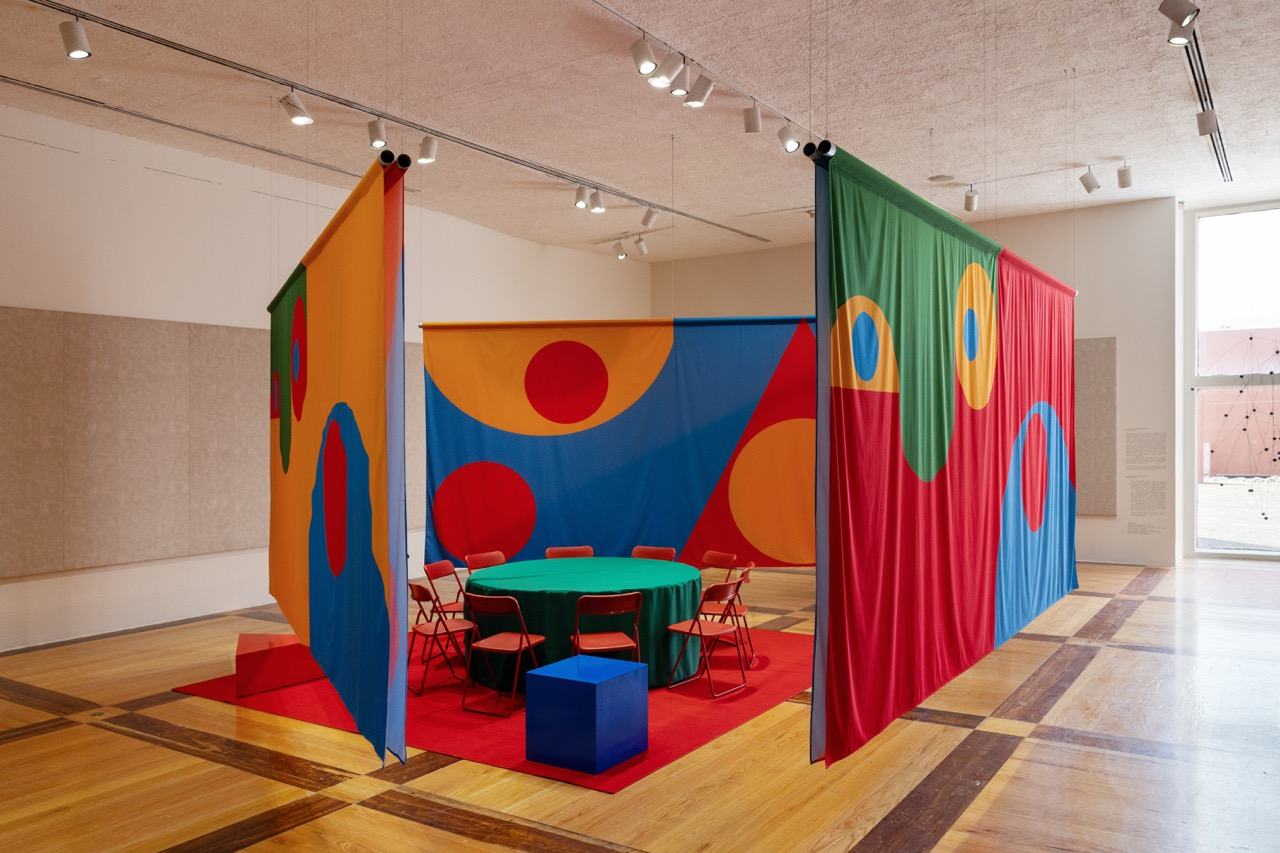
The exhibition was accompanied by a public program that included conversations, workshops, seminars, and interdisciplinary collaborations. Among these were a seminar led by Erika Hirugami on aesthetics, decolonization, rematriation, indigenization, and migration, as well as a workshop led by Mónica Moreno Figueroa on racisms, oppressions, and anti-racist practices in art. Another significant example was Ad Minoliti’s Club de collage especulativo, a commissioned installation activated through workshops with artists, educators, and activists from Monterrey, creating a participatory space, inside the exhibition halls, to explore identity, gender, and artistic practice.
For us, the value of these projects lies not only in sharing knowledge, but also in creating spaces where people can bring their own perspectives, experiences, and questions into the conversation. In this sense, research becomes a starting point for participation, dialogue, and collective learning.
Constelaciones y derivas: arte de América Latina desde la Colección FEMSA, presented at MARCO as part of the 50th anniversary celebrations, brought together 174 works by more than 100 Latin American artists. Rather than constructing a single chronological narrative, the exhibition proposed a series of questions that ran throughout the exhibition.
What initial questions did you pose to the collection, and how did they lead towards the different constellations? In this process, did unexpected relationships emerge between works, artists, or historical moments that allowed you to discover new readings of the collection itself?
One of the starting points for Constellations and Drifts: Art from Latin America in the FEMSA Collection was to revisit the collection without assuming that its history should be presented through a linear or chronological narrative. Instead, we wanted to explore what new relationships could emerge when works from different periods, artistic movements, and geographical contexts were brought into conversation.
This approach draws on the idea of constellations as a form of relational knowledge, associated with Walter Benjamin and with curatorial methodologies developed by Mari Carmen Ramírez, Héctor Olea, and Andrea Giunta. Rather than organizing works according to a fixed historical sequence, constellating enables us to identify affinities, tensions, and unexpected connections among artworks, artists, geographies and decades. These relationships can generate the initial questions and hypotheses from which the exhibition’s thematic sections emerge.
Throughout this process, we explored questions such as: How have artists in Latin America represented and questioned the territories they inhabit? How do artistic practices reflect, challenge, or transform the social and historical structures that shape our region? What connections can be established between different approaches to abstraction, identity, and material experimentation?
These questions informed the exhibition's constellations: Territories: The Symbolic Limits of Geography; Architectures of Colonization: Between Language and Bodies; Debating Abstraction: Geometry and Form in Latin America; Alchemy: Transformation, Transmutation, and Change; and Identities: Identities on the (Im)Possibility of a Chorus. Rather than presenting these as separate or definitive categories, the exhibition invited visitors to move between them and recognize the connections, tensions, and continuities that emerge across different artistic practices.
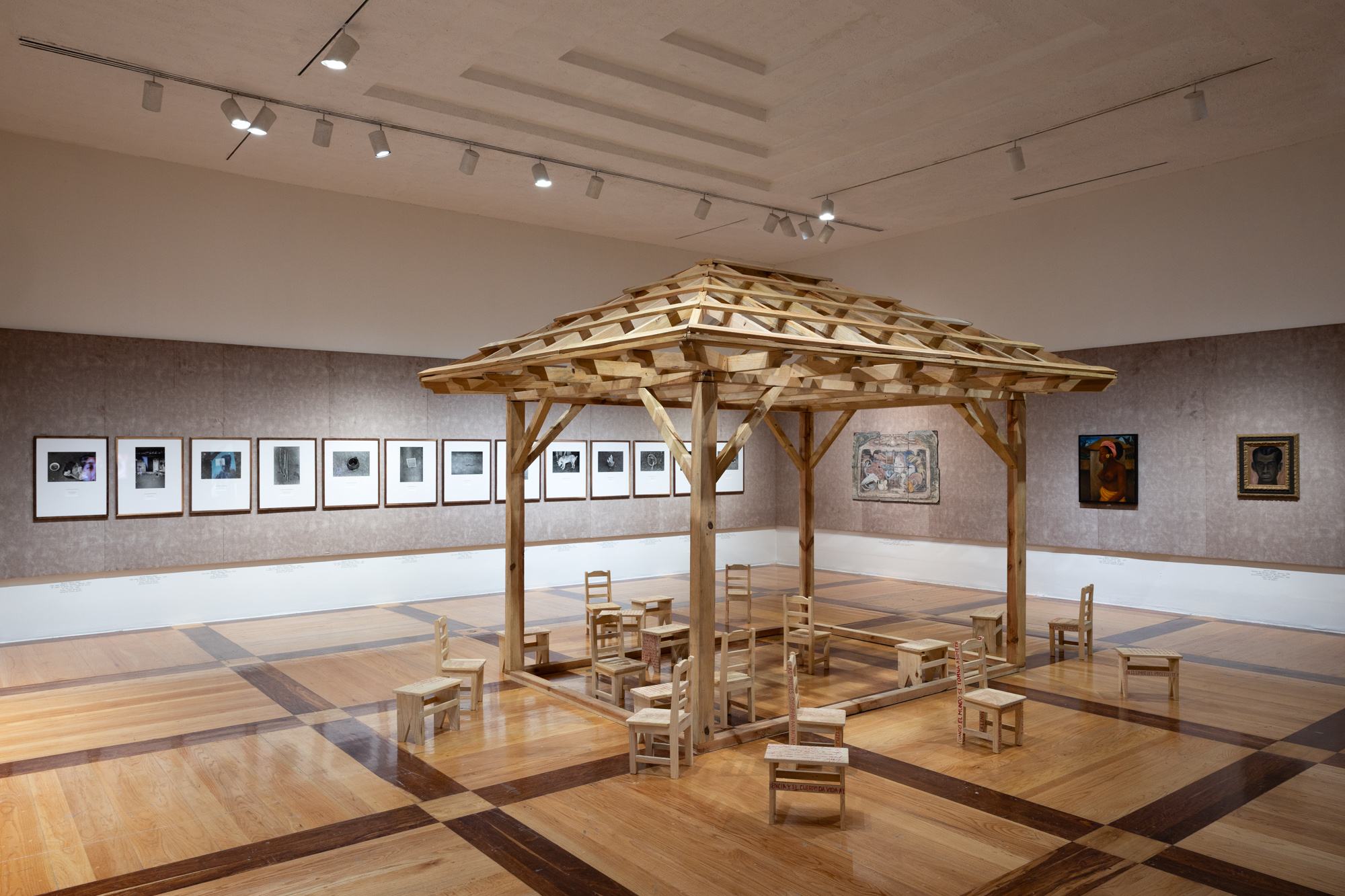
One particularly revealing example emerged within the constellation devoted to abstraction. A Cubist work by Diego Rivera from 1914 was brought into dialogue with a sculpture by Manuel Felguérez that had never previously been exhibited in a museum. The encounter invited a new perspective on artists connected to different moments in Mexican art history, including the ideological debates between the muralist generation and the so-called Ruptura movement. The brutalist architecture of MARCO also helped create a setting in which these works could coexist outside a conventional genealogical narrative.
Presenting these works in relation to Ad Minoliti’s contemporary approach to geometry further expanded the discussion. Through Club de collage especulativo, a playful, participatory space within the galleries, Minoliti reframed collage as a queer artistic practice and questioned dominant twentieth-century narratives that celebrated the male artist as the singular creative genius of abstraction.
In doing so, we came to see the collection not simply as a record of artistic movements or historical periods, but as a space where multiple histories and perspectives coexist. Bringing works into new relationships can challenge established interpretations and open up questions that might not have been visible when looking at them individually.
In the context of the 50th anniversary, you have also spoken about addressing contemporary cultural, social, and environmental issues. In this sense, Constelaciones y derivas proposes a critical and profoundly contemporary perspective on the collection.
Could you share a specific example of how this new perspective has enabled you to reinterpret a work, a group of works, or an aspect of the collection’s history?
One of the most important aspects of revisiting a collection with a history of nearly five decades is recognizing that the questions we bring to artworks change over time. Works acquired in a particular historical or curatorial context can take on new significance when approached through contemporary social, cultural, or environmental concerns.
A particularly revealing example is how our approach to colonial structures changed as we developed exhibitions for two different museums. At MARCO in Monterrey, the constellation Architectures of Colonization illustrated part of the history of the colonial process, with artworks such as La conquista or El mito del oro o El rescate de Atahualpa by Clorindo Testa, and how casta paintings classified and exoticised “Indigenous” people, a gaze that was replicated in some way in representations associated with the so-called Mexican School of Painting, which were contrasted with works through which First Nations artists represent themselves.
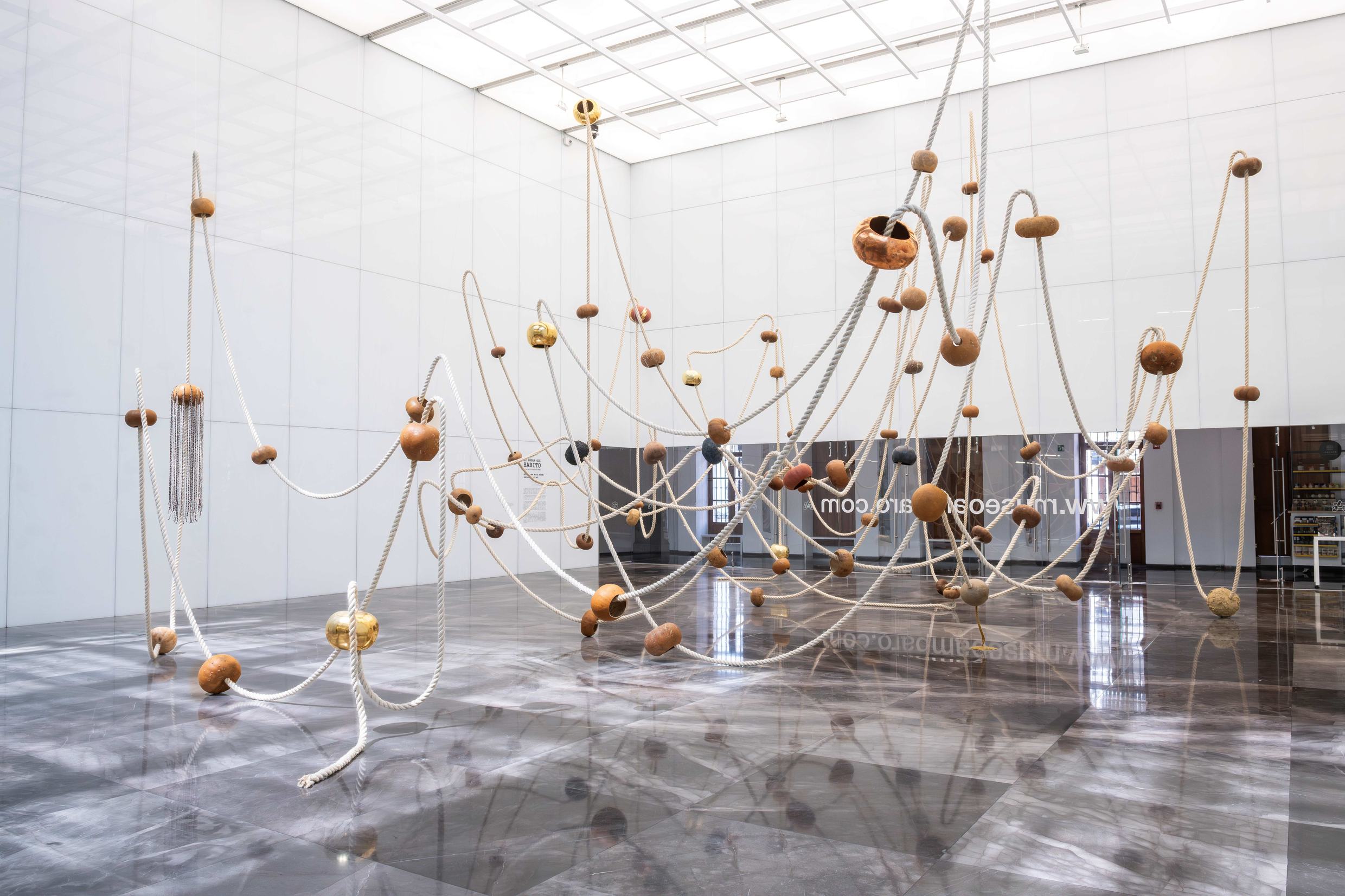
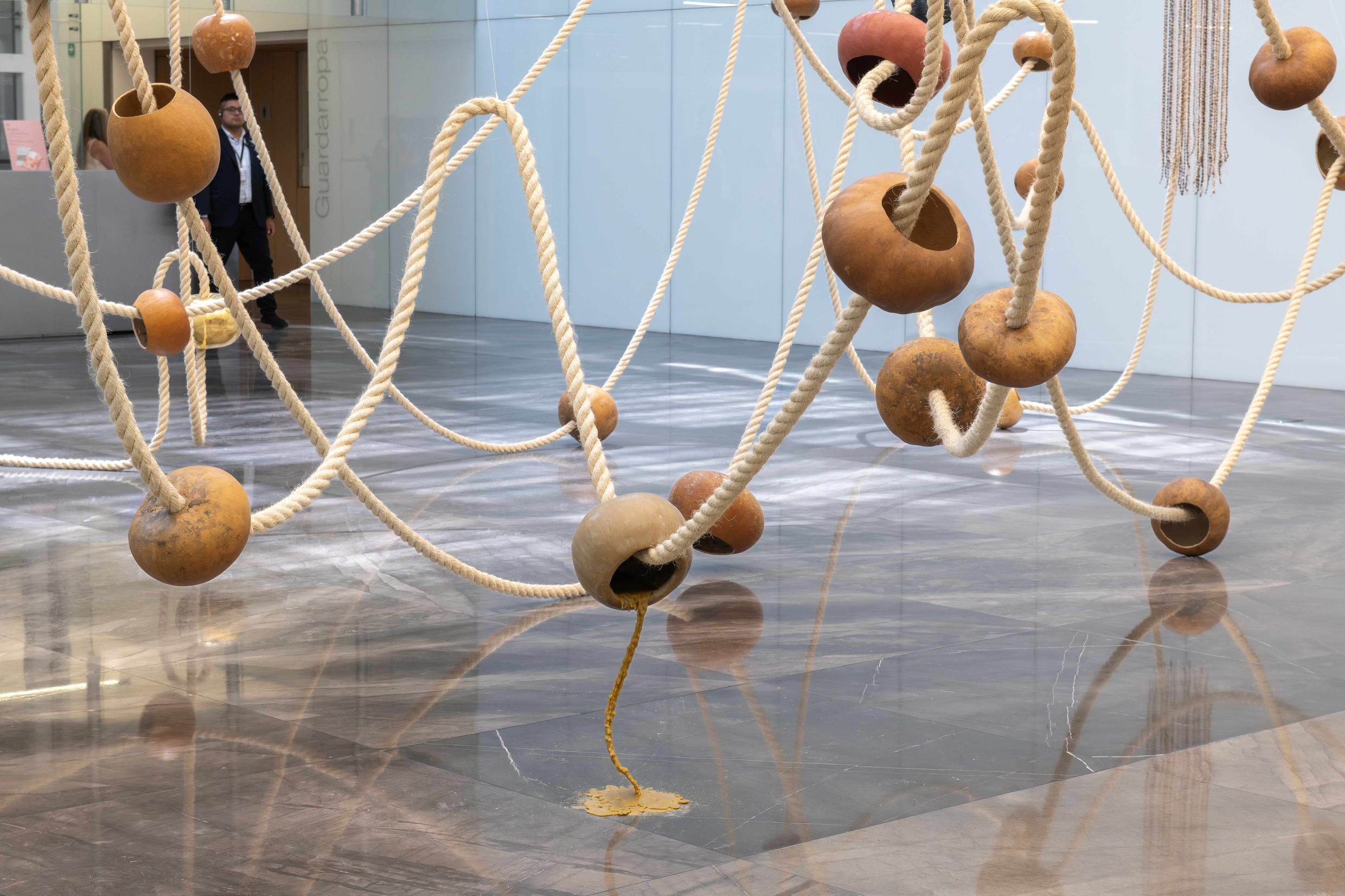
At Museo Amparo in Puebla, the city’s colonial history and the museum’s own context allowed us to develop these questions differently in A Home to Inhabit. We explored in greater depth the relationship between Christian religion and colonial structures, through Francisco Toledo’s Nuevos catecismos para indios remisos, and Nahum B. Zenil’s Santo entierro, while also expanding the discussion of racialization and Afro-descendant histories in Mexico through works by artists such as Aydeé Rodríguez López and Wifredo Lam. This shift made room for histories and perspectives that have often remained at the margins of dominant art-historical narratives.
What interests us about these approaches is that they do not require us to impose a single contemporary interpretation on historical works. Instead, they allow us to establish connections between different moments and perspectives, while remaining attentive to the particular contexts in which the artworks were created.
This process reinforces our understanding of the collection as something that is continually being researched and reinterpreted. Its relevance is not determined only by the historical significance of its works, but also by their capacity to generate new questions and contribute to conversations about the present.
The 50th anniversary offers an opportunity to look back, but also to consider what kind of collection you want to build for the future.
What have you learned from this process of reviewing the collection about the Colección FEMSA you want to build over the coming decades?
The 50th anniversary represents an important opportunity to reflect on how the collection has unfolded and on how we want it to continue developing.
One of the key lessons from this process is that a collection should not be understood as a completed narrative or finished project. Over five decades, Colección FEMSA has brought together works by artists from different generations and contexts, reflecting the diversity and complexity of artistic production in Latin America. Revisiting this history also reminds us that there are always new perspectives to consider, new questions to ask, and areas that deserve further research.
Looking ahead, we want to continue strengthening the collection as a cultural platform that connects art with people and with the challenges societies face. This means maintaining a strong commitment to curatorial research, documentation, and conservation. It also means strengthening the representation of artists from other Latin American countries beyond Mexico, broadening the regional perspectives represented in the collection.
We also believe that the future of the collection depends on our ability to remain open to different voices and perspectives. Working with artists, researchers, museums, and communities allows us to challenge our own assumptions and expand the ways in which the collection can be interpreted and experienced.
Ultimately, we see the anniversary not as the conclusion of a chapter, but as an opportunity to reaffirm our commitment to a collection that continues to evolve, generate knowledge, and create meaningful connections between art and society, and therefore, a responsibility
Colección FEMSA is strengthening its relationship with CIMAM as Major Patron and deepening its engagement with an international community of modern and contemporary art museum professionals.
Why is it important for Colección FEMSA to support CIMAM, and how can dialogue with other institutions and professionals, with a wide range of experiences and contexts, contribute to posing new questions about the collection and imagining its development over the coming decades?
Supporting CIMAM reflects our belief that collaboration and the exchange of knowledge are essential to the development of cultural institutions. As a corporate collection with a public vocation, Colección FEMSA has built its model around working with museums, curators, researchers, and other cultural professionals, recognizing that meaningful institutional development emerges through dialogue and shared experiences.
CIMAM provides an important platform for connecting with an international community of professionals who approach modern and contemporary art from different institutional, cultural, and geographical perspectives. Particularly valuable to us is its ability to connect the Global North and Global South and to bring institutions from different regions into shared conversations.
For us, participating in this network represents an opportunity to exchange ideas, learn from different practices, and contribute to broader conversations about the role and responsibilities of art institutions today. It also allows us to join other voices from Latin America already participating in this international dialogue and to explore how the questions facing our region resonate with those of other regions of the Global South.
As we approach our 50th anniversary, these exchanges become particularly relevant. Reflecting on the future of Colección FEMSA also means expanding established ways of working and considering how we can continue to respond to changing cultural and social contexts.
We believe that the most meaningful way to imagine the future of a collection is not in isolation, but through ongoing conversations and collaborations that challenge, enrich, and expand our perspectives.