Architecture of Diffuse Boundaries
Article written by María Eugenio Cordero, Director of the Museo Barda del Desierto (mBDD), Northern Patagonia, Argentina. Project recognized with the Outstanding Museum Practice Award 2025.
What Can a Museum Do at the Edge?
Contemporary approaches to museum-making are increasingly shaped by diverse structures, practices, and relationships. These broaden the question of museum architecture and shift attention toward the functions that make its existence possible: what it preserves and how, how it constructs knowledge, how it organizes its holdings, how it produces experiences, and how it establishes lasting relationships with its context.
Museo Barda del Desierto [mBDD] is located in the Northern Patagonian steppe of Argentina, across an area of seventy hectares in the province of Río Negro. Its practice brings together contemporary art, architecture, digital technologies, and pedagogy in direct relation to the cultural geography of the region. It takes shape as a museum architecture at the edge, between landscape and digitality.
The edge is both a geographical condition and a position from which to question ways of imagining an organism capable of generating relationships between art and community. Inhabiting this edge means engaging with different infrastructural conditions, dispersed communities, and vast territorial distances—conditions that make it possible to explore different temporal scales of proximity, exchange, and knowledge.
Thinking about territory through a museological practice means recognizing a landscape composed of overlapping historical strata, social relations, political and economic decisions, and forms of representation. In Northern Patagonia, a historical, social, and political narrative surrounding the concept of the desert persists, contributing to the invisibilization of the Indigenous peoples who inhabited the region prior to colonization and to the devaluation of the steppe within the collective imaginary.
The fruit-growing valley of this region is an artificial construction occupying a narrow strip along the Limay, Neuquén, and Río Negro rivers, where much of the population is concentrated. The steppe, where the museum is located, remains at the edges of this territorial organization. The idea of the desert and its affective and symbolic devaluation, sustained by colonial narratives, facilitates extractive practices that stand in opposition to a culture of care and environmental protection. In recent decades, the expansion of hydrocarbon extraction associated with Vaca Muerta has introduced new forms of exploitation and territorial occupation: areas traditionally devoted to agriculture now coexist with infrastructure associated with fracking.
It is within this landscape of ongoing tensions that Museo Barda del Desierto develops its practice. Its cultural geography constitutes an active field of research, and contemporary artistic practices make it possible to approach its transformations through other forms of knowledge.
From Antecedent to Holdings
This way of investigating the territory began in 2014 with an international artist residency program in Contralmirante Cordero. For six years, artists, researchers, and the community shared periods of work and exchange at the town’s primary school, producing works through direct engagement with the cultural geography of Northern Patagonia.
These practices formed an archive that preserves the circumstances in which each work was produced: a place, a displacement, and a shared experience. We refer to these circumstances as its antecedent. From this archive, a pact was established with the artists: to recover and sustain over time the experience constructed collectively, and to allow the works to remain connected to the territory where they were created. The holdings of mBDD emerged from this agreement.
The holdings thus bring together the works and preserve an artistic memory produced from the landscape, along with the possibility of reactivating it. The question of conservation therefore acquires another dimension: what does it mean to preserve a work when its materiality is also composed of temporalities and affective experiences that have taken place within a territory?
It is within this dimension that the first museological operation takes place: returning to the territory. Geolocating each piece establishes a coordinate between the work and its place of origin. The coordinate functions as spatial information while reconnecting the work with the site where it was conceived. In this way, geolocation begins to operate as a device of conservation. The geolocated points connect to one another, forming a digital map that establishes relationships with physical movement and makes it possible to navigate the holdings. The body then enters a new spatial organization.
Architecture of Diffuse Boundaries
The map operates as the plan of the museum. Like any architectural plan, it establishes positions, connections, and routes. In this case, the plan is superimposed onto the territory it represents. Visitors can locate themselves within it while simultaneously moving through physical space. The relationship between map and landscape ceases to be merely referential: both participate in the same spatial organization.
At Museo Barda del Desierto, the relationship between physical space and digital mediation constitutes its architectural condition. The museum draws on the principles formulated by the Japanese architect Toyo Ito in Blurring Architecture, in which the boundary operates as a membrane of exchange between interior and exterior.
This principle provides the theoretical point of departure for the mBDD’s research into an Architecture of Diffuse Boundaries. Physical territory and the digital dimension operate simultaneously. The boundary becomes an active condition between landscape and map, body and work, interiority and exposure.
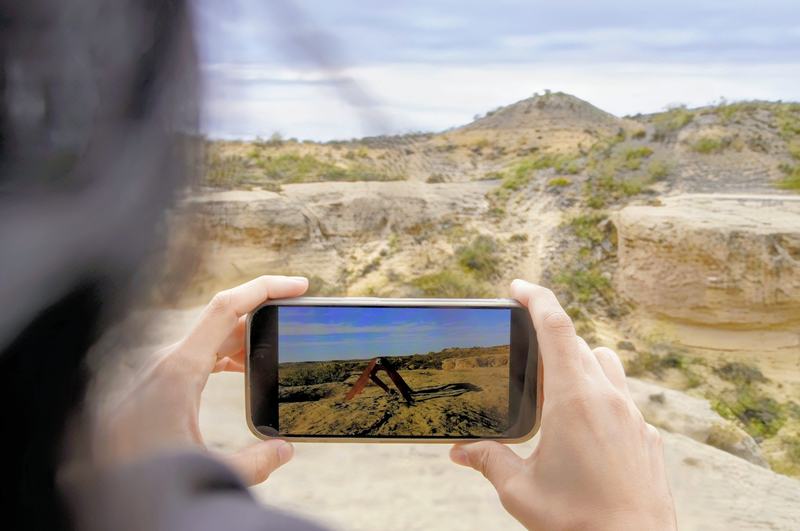
The work thus exists under two conditions: its digital existence and its relationship with physical space. The mobile device provides access to it, but the experience is completed through its relationship with the territory. Screen and landscape operate simultaneously, constantly articulating perception between what lies before the body and what the device makes it possible to see, hear, or imagine again. We call these spatial relationships topogenesis.
Topogenesis refers to the generation of place through the aesthetic experience that emerges among body, imagination, and sensation. The architecture of mBDD is constructed through a process in which individuals find, within the boundaries of this interiority/exposure, the measures that give unity to the inhabited place.
The Museum Is a School
Art-education practice forms part of the body of work of Museo Barda del Desierto. Its programs establish ties with schools, teachers, institutions, and communities throughout the region, generating spaces of exchange through contemporary artistic practices and direct experience with the territory.
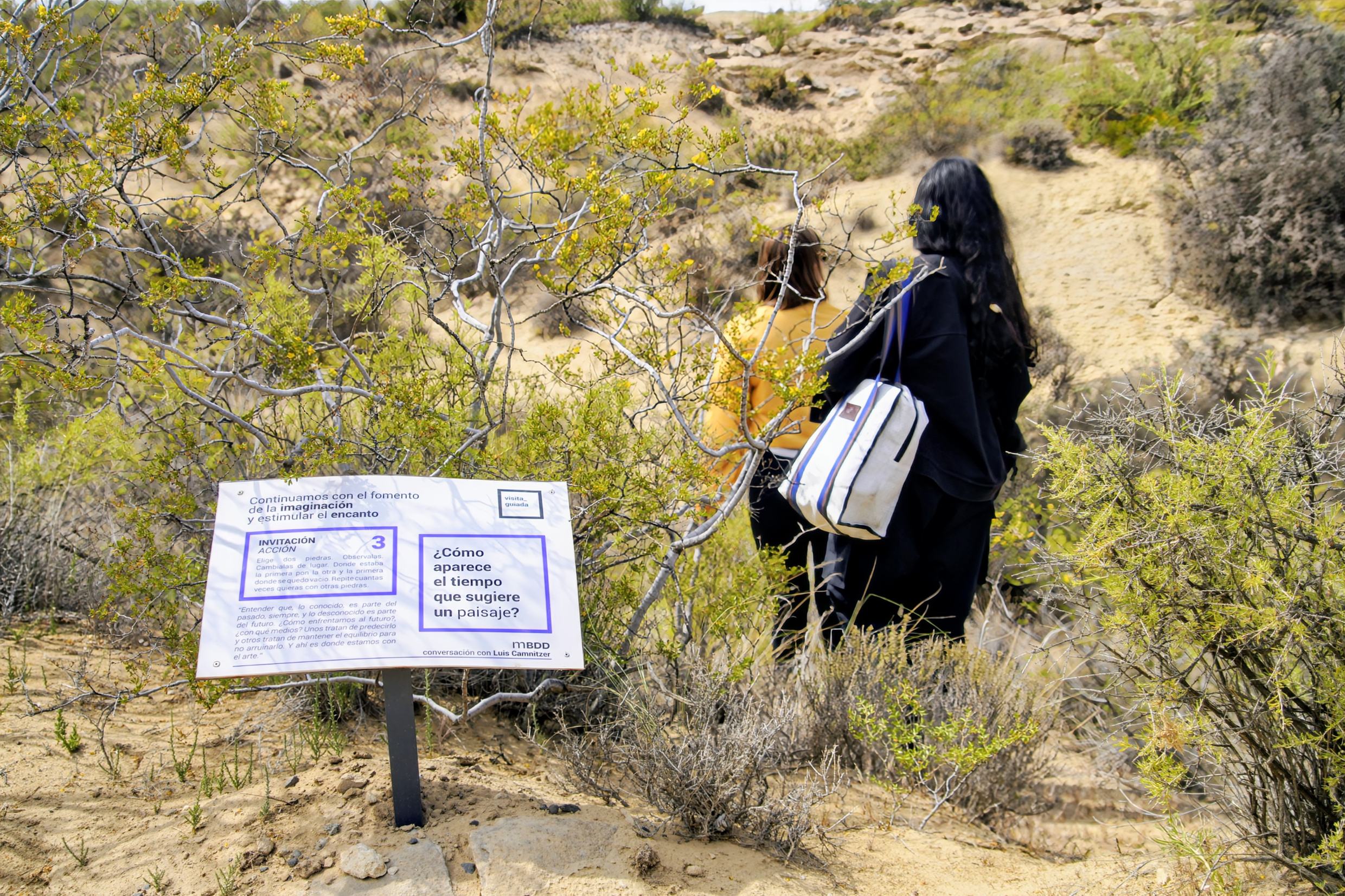
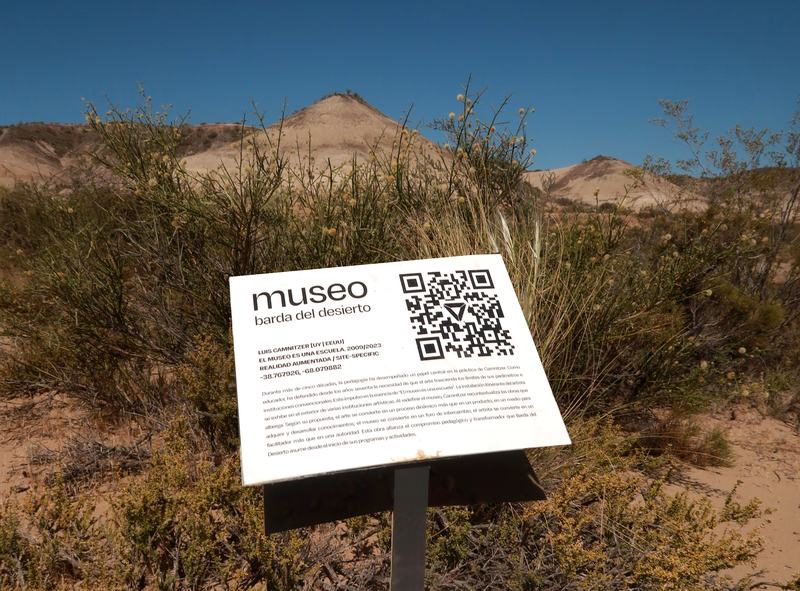
One of these art-education programs is linked to Luis Camnitzer’s work The Museum Is a School, developed in augmented reality and incorporated into mBDD’s holdings during 2023–2026. Its incorporation gave rise to a conversation with the artist and, subsequently, to the development of a permanent self-guided route that invites visitors to move through the museum by means of questions, actions, and exercises integrated into the circuit. These simple actions modify attention and generate other possibilities for affective relations among perception, artwork, and landscape.
In this territory, building audiences also means building continuity. A school visit, a family moving through the museum, or a group participating in an activity are experiences that exceed their quantitative dimension and acquire consistency when they can be sustained over time.
For this reason, generating an affective relationship with the Patagonian steppe through contemporary artistic practices constitutes a central part of mBDD’s work. Poetic languages offer other ways of perceiving a territory historically associated with ideas of emptiness, unproductivity, and desert. Producing experiences and questions from this edge also makes it possible to construct knowledge, affective relationships, and a sense of identity and belonging.