New Castle Art Gallery
Newcastle Art Gallery is Australia’s largest regional public gallery. The Gallery’s collection and artistic program reflect a deep commitment to the importance of art and artists.
One of the Gallery’s central tenets is honouring and celebrating Aboriginal and Torres Strait Islander First Nations culture. Through collecting, exhibitions, and programs, the Gallery creates culturally safe and welcoming spaces.
The Gallery is deeply anchored in our local community, committed to placing the work of artists from Newcastle in the context of their national and international peers, and to bringing artists and works of significance to Newcastle. Our visitors can enjoy works by local, national, and global artists across thirteen galleries.
The Gallery’s collection comprises more than 7,000 works of art, primarily modern and contemporary. Iconic works of art of national and global significance by modern and contemporary artists include those by Sally Gabori, Jonathan Jones, Emily Kam Kngwarray, Tracey Moffatt, Archie Moore, Sidney Nolan, John Olsen, and Brett Whiteley, alongside the largest collection of avant-garde Japanese Sōdeisha ceramics outside Japan.
The Gallery reopened in February 2026 following a major expansion that more than doubled the footprint and provided international standard facilities.
Name of the director of the institution: Lauretta Morton OAM
Name of the practice, initiative or program nominated: Access-led architectural sculptures by artist Fayen d’Evie
Name and position of the professional who leads the practice: Miriam Kelly (Head of Curatorial and Exhibitions) and Peter Johnson (Curatorial Lead)
Describe the practice, program, or project, what innovative approach is proposed, and in which core museum activities it applies: conservation, education, collection, exhibition programs, publications, research, accessibility, communication, governance, and sustainability.
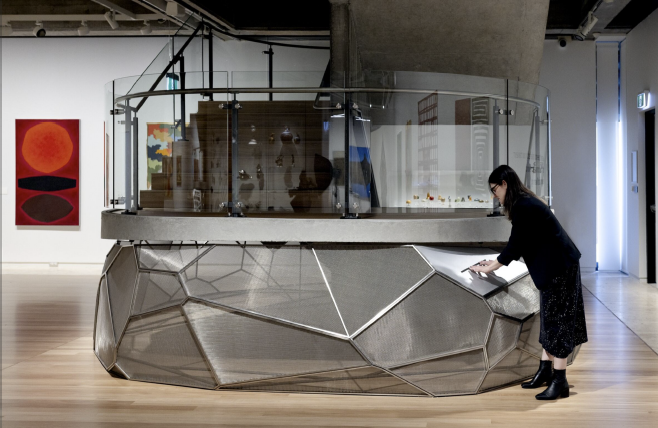
Newcastle Art Gallery commissioned internationally renowned artist, designer and academic Fayen d’Evie to develop a new artist- and disability-led site-specific sculptural resolution to a common building hazard.
In the existing 1977 Gallery are two striking brutalist concrete staircases that were originally designed to appear floating and unsupported. They were identified as posing a significant safety risk for visitors who are blind or have low vision and, as part of the Gallery’s recent expansion, remediation was required to meet contemporary safety and accessibility standards. This is a challenge faced by many public spaces, particularly with architectural heritage.
In a world-first response, d’Evie developed an artist-led and disability-led solution that reimagines functional barriers as sculptural interventions. Now on display, two large-scale tactile sculptures, collectively titled ‘( reflecting air ) “…Touch enabled her to discern minute details… which often pass unnoticed…”’, form a permanent and integral element of the Gallery’s expanded building.
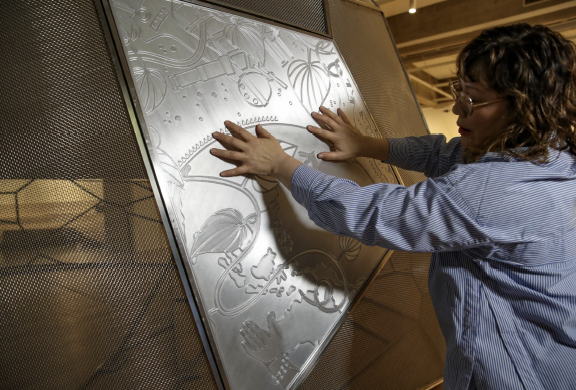
These sculptures actively invite touch and operate as shared points of encounter, prompting dialogue and exchange between blind and sighted visitors.
The elegant steel forms of ‘( reflecting air )’ incorporate aluminium panels featuring one-to-one scale tactile translations of works of art from the Gallery’s collection, etched, routed, and brushed using bespoke methodologies. For each of the six selected works of art, a unique translation process was developed to convey not simply surface form, but the experience of being in the work of art’s presence. Additional tactile elements include geological core samples extracted from 80 metres below the Gallery site during construction, alongside Braille text embedded within the sculptural forms. ‘ (reflecting air) ’ also serves as a catalyst for intersensory programs and conversations.
Together, the sculptures embed blind ways of knowing into the fabric of the building itself, transforming an architectural hazard into a powerful, enduring model of inclusive museum practice.
Explain in one sentence why you think the project you nominate is outstanding and could serve as an example for the entire community of modern and contemporary art museums.
By centring blindness at the heart of the Gallery, this artist and disability-led project establishes new best-practice access standards for built design and programming in museums and cultural facilities.
Explain why this practice or program is relevant and sustainable in creating meaningful and lasting connections with people, communities, and the museum context with a medium to long-term vision.
This project’s longevity and power lies in artist Fayen d’Evie’s central provocation: to turn a barrier into an invitation. Symbolically and literally, the sculptures embed blindness and blind ways of knowing into the fabric of the Gallery building.
This practice is relevant and sustainable because it embeds access as a permanent and generative part of the Gallery’s physical and cultural infrastructure, reframing accessibility from compliance to shared cultural experience. The sculptures create meaningful connections by inviting tactile, intersensorial engagement and fostering dialogue between blind and sighted visitors, challenging inherited hierarchies of perception within galleries and museums.
Long-term, the sculptures will remain active catalysts for learning, conversation, and programming. Their integration into the building ensures ongoing relevance, while collaboration with the Gallery’s public programs and learning teams sustains evolving forms of engagement. This practice establishes an enduring model for inclusive museum practice that resonates across communities and generations.
What are the outcomes of the practice you are most proud of?
The outcomes of this practice we are most proud of are both practical and enduring. Central to the project is the development of bespoke tactile translation methodologies that attend to the experience of works of art. Rather than producing simplified depth maps, the aluminium panels translate presence, movement, and material sensation from sight to touch.
Equally significant is the permanent integration of ‘( reflecting air )’ into the Gallery’s architecture. By embedding access-led sculptures into the fabric of the building, this commission project avoids being time limited or programmatic and instead establishes access as an ongoing condition of the Gallery.
Developed in dialogue with Gallery staff, the sculptures have already generated choreographic responses by local dance company Catapult and a score composed and performed by musician Zackari Watt. These outcomes demonstrate how access can operate as a creative and cultural driver within museum practice.
How has the nominated practice changed your methods and ways of working?
This practice has led to substantive shifts in how the Gallery approaches curatorial work, interpretation, and public engagement. The principles of universal design are central: that making processes, programs, and infrastructure more inclusive benefits everyone.
The project has resulted in the ongoing engagement of Fayen d’Evie as both artist and access consultant, including her contribution to the Gallery’s Digital Audio and Access guide. Her involvement has reshaped how we formulate interpretative material, embedding multiple voices and ways of understanding.
The project has prompted a more deliberate approach to working with artists with disability and/or neurodivergence, and the centrality of care and making access explicit from the outset of all artist engagement.
More broadly, the project has centred accessibility within programs for all visitors. Guided tours and schools programs in particular have been informed by inter-sensorial approaches that support multiple ways of learning and engaging with works of art.