Museum of Art & Photography
Museum of Art and Photography (MAP) is a modern and contemporary art museum in Bengaluru, India, committed to expanding access to art and visual culture from India, South Asia, and globally. Over the years, MAP has positioned itself as a space for dialogue, research, learning, and community engagement with a strong emphasis on accessibility, inclusive participation, and meaningful engagement with digital technologies. Since opening in 2023, MAP has welcomed more than 300,000 visitors, many of whom are under 35 years of age and visiting a museum for the first time. Through our education and public programming, MAP continues to reimagine what a modern museum can and should be, a site for knowledge production, capacity building, and developing models for equitable cultural infrastructure across South Asia. MAP’s collections span from the 2nd century to the present, encompassing living traditions, pre-modern, modern, and contemporary art, photography, popular culture, textiles, design, and material cultures, reflecting the museum’s commitment to access, scholarship, preservation, and public engagement.
Name of the director of the institution: Arnika Ahldag
Name of the practice, initiative or program nominated: Museum in a Box
Name and position of the professional who leads the practice: Shubhasree Purkayastha, Manager - Education
Describe the practice, program, or project, what innovative approach is proposed, and in which core museum activities it applies: conservation, education, collection, exhibition programs, publications, research, accessibility, communication, governance, and sustainability.
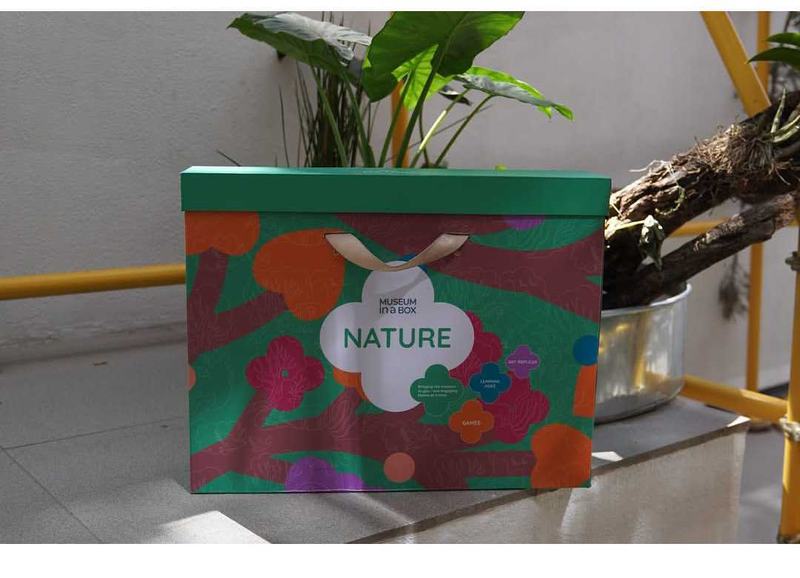
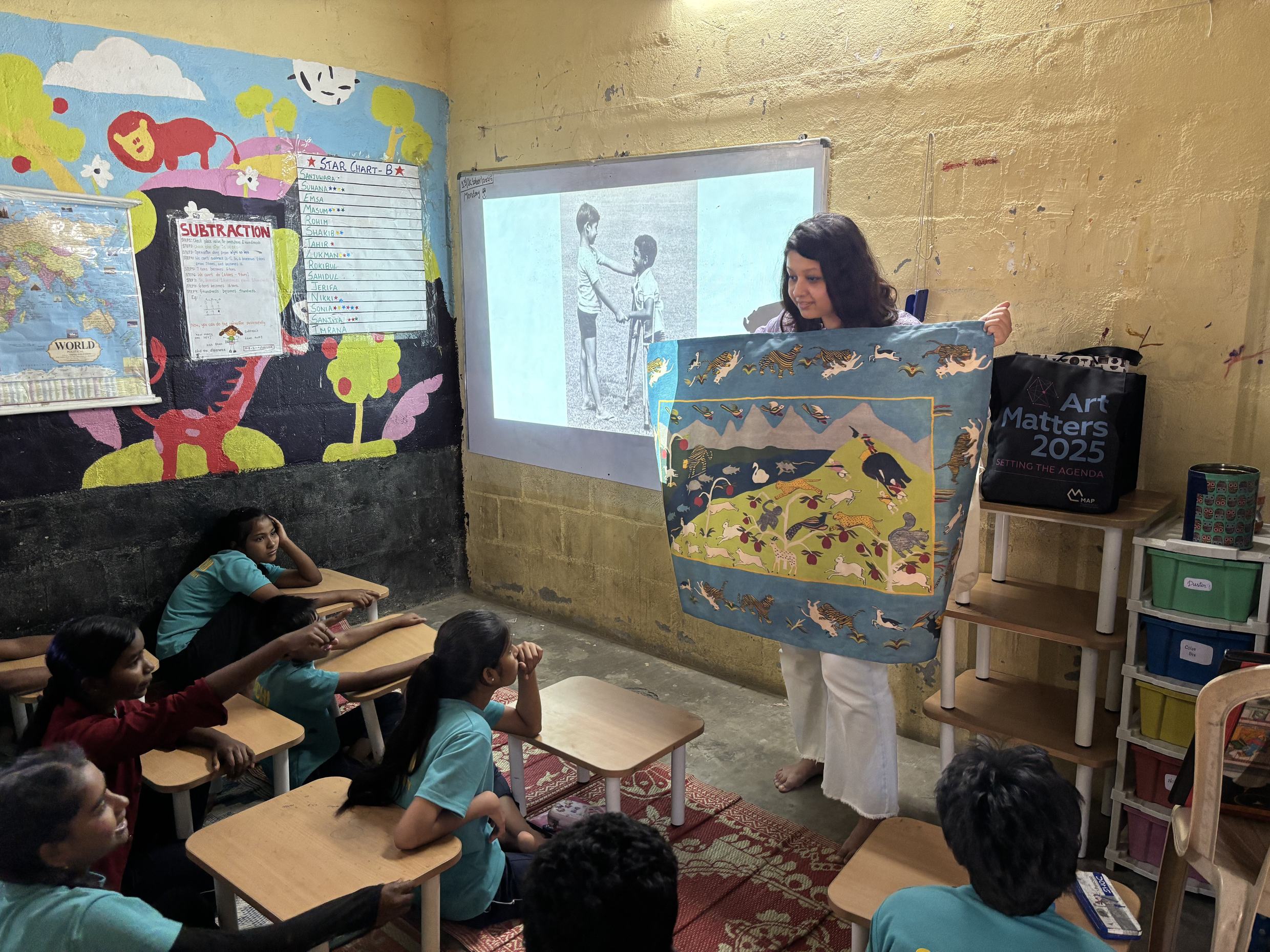
Museum in a Box is envisioned as both a project and an ongoing practice, a way of bringing the museum into classrooms to make art-integrated learning accessible to students from marginalised and structurally excluded communities who do not otherwise have access to the arts or museums. In other words, if students cannot come to the museum, the museum goes to them. The project travels as a resource kit containing replicas of artworks from MAP’s collections, learning aids, and thoughtfully curated, curriculum-linked modules. It intersects with five core museum activities: education, accessibility, collection, exhibition, and sustainability. Piloted for the first time last year, the kit is designed for students in Grades 5-7, and integrates art across Math, Science, Language, Visual Arts and Social Sciences, and is currently in English, with plans to expand to Hindi and other regional languages in future iterations to better accommodate the needs of students.
The boxes are organised around distinct but interconnected themes: Nature, Structure, and People, designed to build on each other and offer holistic learning experiences, where the learners move from discovering the world around them to recognising their own ways of seeing and their agency within it. For instance, in one of the modules within the Nature Box, learners explore systems in nature through the lens of food chains and interdependence. The journey begins with an icebreaker in which students embody roles like tree, deer, tiger, and vulture, enabling them to physically understand the flow of energy from producers to consumers. As they move into the close-looking stage, the Shikargah Dhurrie, a flat-woven rug dating to the 1940s, becomes a site of discovery, where learners trace these relationships within the artwork and recognise how plants, animals, and humans are interconnected within an ecosystem. In the create stage of the module, learners construct their own habitat collages, carefully identifying producers, primary and secondary consumers, and scavengers. Through this progression, they move from observing nature to understanding its balance, while also beginning to recognise their own role within it, developing a sense of care and responsibility towards the resources that sustain life across ecosystems. Through this approach, Museum in a Box is not just an add-on to classroom learning, but becomes a meaningful entry point that enables students to engage with their subjects and the world around them in a more reflective and analytical lens.
Explain in one sentence why you think the project you nominate is outstanding and could serve as an example for the entire community of modern and contemporary art museums.
In India, where art education is largely absent from school curriculum and established learner-centric methodologies often struggle to foster critical thinking and dialogues, Museum in a Box, offers a transferable and sustainable model for how modern and contemporary museum’s collections and practices can actively bridge some of these gaps, enabling students to connect curricular learning to real world and develop their own voices through reflections and creative self-expression.
Explain why this practice or program is relevant and sustainable in creating meaningful and lasting connections with people, communities, and the museum context with a medium to long-term vision.
The long-term vision of Museum in a Box is for partner schools and nonprofit organisations working towards educational equity in India to retain the boxes permanently and use them across successive batches of learners. In this process, the museum moves away from being a physical space of one-time visit into a continuous, accessible learning space, built on artworks, storytelling and dialogues, that fosters an evolving relationship between learners, communities and MAP, one that outlasts any such project cycle.
To support this, the project is developing several systems, such as translation of materials into regional languages like Kannada, Hindi and others; a train- the- trainer model to develop local facilitators’ capacity to use the modules and materials in response to students' needs; and ongoing impact assessment to evaluate both the materials, practice, and the project’s impact on learners. This approach is particularly relevant in the broader Indian context, where the National Education Policy (NEP) 2020 promotes arts-integrated learning, but its professionalisation remains limited, with a shortage of trained educators, especially outside urban centres. It also responds to some of the systemic challenges seen in the contexts of Karnataka’s education landscape, where activity-based programmes have been rolled back due to inadequate resources, results, and insufficient teacher support. Here, by combining museum-based pedagogy with sustained facilitators training and accessible resources, Museum in a Box ensures meaningful, sustainable, and long-term engagement with wider communities.
What are the outcomes of the practice you are most proud of?
In its pilot year, Museum in a Box reached over 200 students across 8 schools and 3 NGO partnerships. The outcomes we are most proud of are the broader behavioural and dispositional shifts in learners. For instance, students who were shy and underconfident have opened up considerably, a direct result of a learning environment and practice where there is no right or wrong answer, a pattern consistently observed by facilitators and established in the design of the project itself. Students have begun forming opinions and asking questions about real-world concepts, such as law, public infrastructure, migration, and others, demonstrating genuine reflection and critical thinking. Observation and analytical skills have also improved significantly, built through the practice of repeated, patient looking at and discussing artworks. This is best illustrated by the words of one of the facilitators who led the session on mapping built environments, where students were encouraged to develop mathematical thinking, communicate ideas logically through data visualisation, and build the interpretation skills to create and read maps of their school campus. The facilitator reflected, “One of the students built his school map as a tree, another created it in the way of a traditional map with top view, another student made it like rooms in a single-floor house. The last section of the module, master-plan emotion mapping, was the one that revealed a lot to the class about how they use spaces in their school and their emotional connection with these spaces – a lot of stories came up as to why they consider one place as a space of inspiration and the other as a space of boredom.” In many ways, these reflections capture the impact of the project, not just as an educational tool, but as a catalyst for students’ curiosity, self-expression, and deeper engagement with the world around them.
How has the nominated practice changed your methods and ways of working?
Museum in a Box is a primary example of how MAP thinks about its collections, audience, and a museum’s ever-evolving role in the community. In South Asia, and more specifically in India, museums, and modern and contemporary art in particular, are widely perceived as elite, intellectual, and distant spaces that subtly reinforce who belongs and who does not. This project is MAP’s intentional effort to actively challenge that perception, making art more accessible not just through messaging, but through pedagogical practice. Taking artworks from MAP’s collection into classrooms, especially in structurally excluded/ disadvantaged communities, has required us to reconsider how each artwork can be connected to learners’ curriculum subjects, and how they are presented, framed, and made meaningful outside traditional art spaces. Here, artwork and museum practice travel and, in many ways, exist in new contexts and speak to an entirely new audience. Further, this has also challenged and shaped our internal ways of working, from collaborating and co-creating across education and design teams to develop the materials, to reconsidering who the museums and the artworks want to connect with, and what meaningful, sustainable engagement actually looks like. It has also pushed us to think more intentionally about inclusive and context-responsive design across very different and specific settings, foregrounding the development of the learning experience itself for students.
https://drive.google.com/file/d/1BOjAuQOgxvts3NwHdXNxgr8OYFapZiN6/view?usp=drive_link